Yellowstone — The Ground Beneath Us
The volcano is not one feature within Yellowstone. It is the ground beneath us.

Setting
Yellowstone National Park, Wyoming
Spring afternoon
44.460364° N, 110.828219° W

Observation
The volcano is not one feature within Yellowstone.
It is the ground beneath us.
Across the park, fumaroles hiss as steam and gases escape through openings in the earth. Hot springs and pools appear inviting, their clear water and improbable colors disguising temperatures capable of scalding. Acidic mudpots churn and collapse, carrying the smell of sulfur into the air.
At Mammoth, mineral-rich water trickles over travertine terraces while rising vapor intermittently obscures the tiers. Elsewhere, geysers erupt according to their own rhythms, some without warning. Except for Old Faithful, whose relative predictability has made it the most famous of them all.
Boardwalks create narrow passages across ground that cannot safely be crossed. From them, the features can seem like individual curiosities: one pool, one vent, one column of water rising into the air.
Together, they are the visible expression of something much larger.
Moment
Across Yellowstone, something appears to be missing.
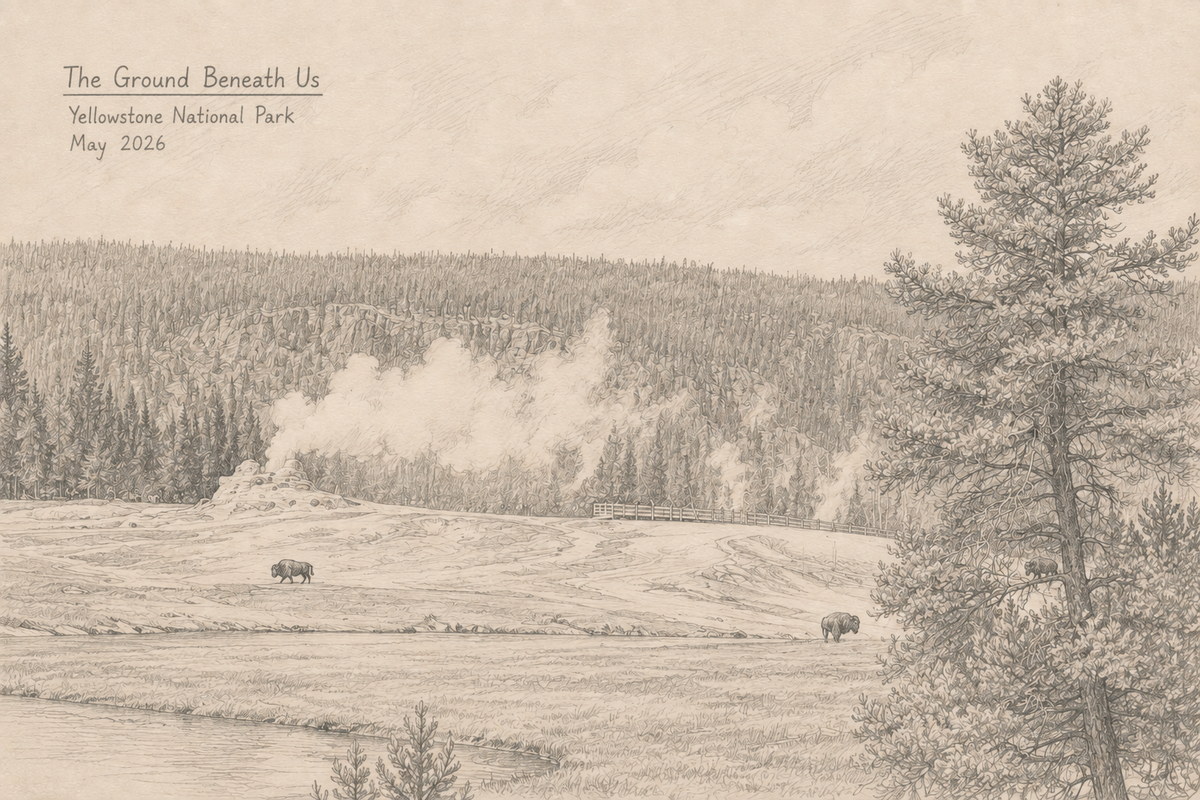
There is no towering cone. No single mountain announces itself as a volcano. Pine forests and open valleys dominate the landscape. Rivers pass through broad meadows. Canyons, waterfalls, and wildlife occupy our attention.
Even with evidence all around us, the realization comes slowly: we have been traveling across the floor of an active caldera.
The pools, vents, mudpots, terraces, and geysers are not separate attractions scattered throughout the park. They are different expressions of the same immense volcanic system.
It isn’t the geysers that change how we see Yellowstone.
It is realizing that they are all connected.
Reflection
What appears separate on the surface may be deeply connected beneath it.